
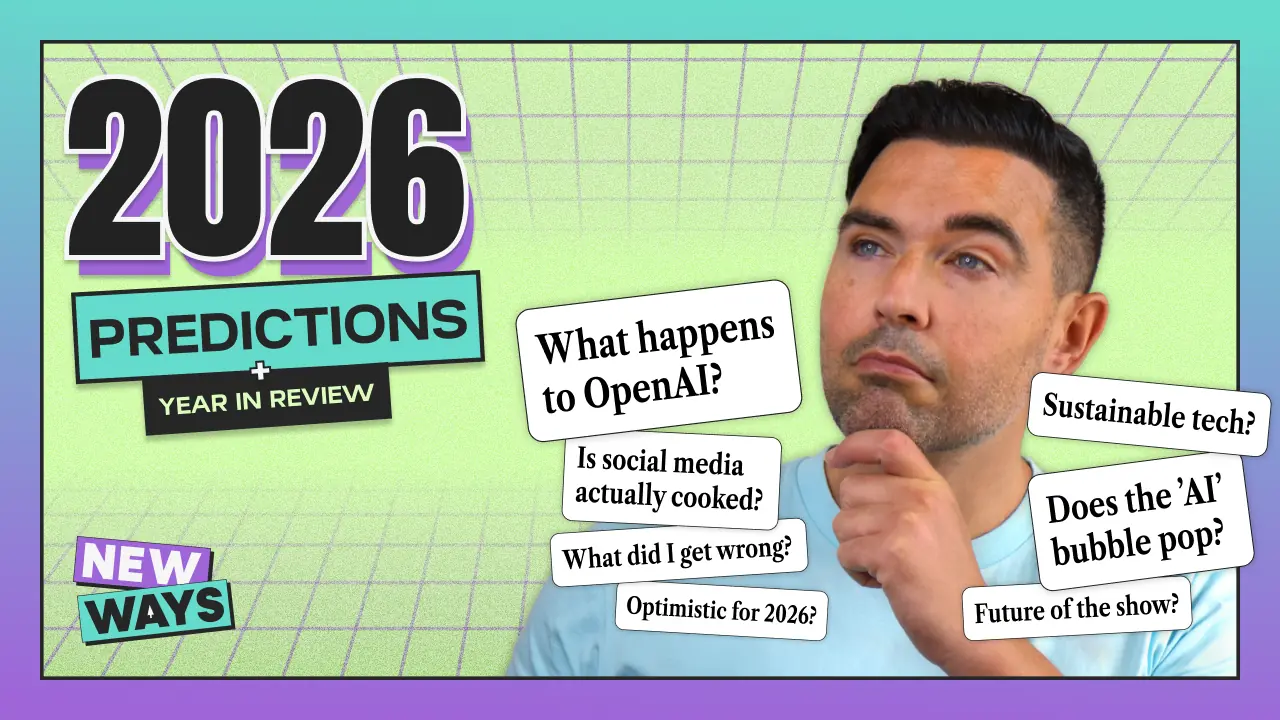
Greetings friends, and welcome to the second annual AMR holiday special! I hope you are all having a wonderful start to the year and enjoying some restful and relaxing time off. This is actually our first episode of 2026, and we’ll be back to our regular schedule of interviews and solos shows from next week.
How this works
Similar to last year’s holiday special, I’ll be making some predictions for the year ahead, but before we get to that, we should review last year’s predictions and guestimations, to see what I got right, what I got wrong, and then finish with some reflections on the show for 2025 and a look ahead at what’s in store for next year.
Last year’s predictions
First up, let’s review the predictions that were made last year. There were six in total, three on social media, and then one each on sustainability, anti-trust and ‘AI’.
My first prediction was that the US TikTok ban would be successful. On that, I was right… but it was more of a win on technical grounds. To jog everyone’s memory, the US Government passed a ‘ban or divest’ law that targeted any ‘foreign adversary controlled applications’, deeming them as a potential national security risk. The big target here was TikTok. After much hoopla, the ban went into effect on January 19th, TikTok was blocked in app stores within the US, and hundreds of millions of users were pissed. However, negotiations between the the US and China kept going, President Trump issued executive orders to extend the deadline for a potential sale, and TikTok quickly found itself back online in the US. And just last month, TikTok signed a memorandum that it intended to sell 50% of it’s US operations to a group of investors including Oracle, Silver Lake and MGX. So, to recap, the ban was “successful”, then it wasn’t, but it kinda… was? I suppose it depends on who you ask.
10 points for Gryffindor.
Next, I predicted that BlueSky would hit 50 million users in 2025. On that, I was wrong… but only by about 30%. See, back when I made that prediction, BlueSky was sitting at around 20 million users, and was growing at a steady pace, thanks to all the turbulence over at X/Twitter and due in no small part to the falling popularity of one Mr. Musk, his wild antics and controversial platform policies. Fast forward one year later, and BlueSky is now at…. drumroll… 41.5 million users. So they more than doubled their userbase in a single year. I was off by less than 10 million. Actually, when I say it like that it doesn’t sound very close at all.
We’re one for two.
Thirdly, this one is a two-parter. I predicted that we’d will see more countries follow Australia’s decision to ban social media for under 16’s, but the public would pushback over the threat of a national digital ID and force governments to put the onus of verification on to app marketplaces and social apps themselves. Let’s tackle the last part first. As it stands, Australia’s Online Safety Amendment, which is the name of the act of parliament prohibiting social media use for those under the age of 16 – I made a video about this recently, link in the show notes – this law evolved over it’s life to require enforcement by social media platforms themselves, and not the use of a national ID… at least yet. However, the evolution was more of a ‘watering down’ of the potential operational requirements to be made upon social media companies, in order to comply with the then-proposed ban, rather than any sort of public freak out. Originally it was floated that these companies should be held to greater account for their algorithmic content, which, had it passed, would have been a truly landmark law and actually made a positive impact for the wellbeing and mental health of our younger population. Which, on face value at least, is what this law was supposed to achieve. And circling back to the first part, as it relates to other countries and their own social media bans for young people, the world now appears to either be in a ‘wait and see’ mode, or perhaps a ‘we’ve got bigger stuff going down right now mode’. That said, there have been renewed calls in the US to try once again to revive the similar Kids Online Safety Act, along with a recent vote by the EU to put in place a modified version of Australia’s ban. So, whilst those laws are not yet in effect, the US is moving ahead and the EU is quote “watching and will be learning” from what is happening here in Australia. So, this prediction I am going to score as a yes… but it is definitely a story to watch in 2026.
That’s two for three.
Next up, I predicted that Google will not only have to give up Chrome, but also will be taken up on it’s counter-off to have its favourable search deals annulled. Now, you might recall that there were several Big Tech anti-trust trails going on in 2025. This one had to do with the US Department of Justice claiming that Google was operating an illegal monopoly in the search engine and search advertising space, which ultimately became the verdict of said trial. In the initial remedies phase, their was talk of Google having to give up ownership of their Chrome browser, also possibly the Android mobile operating system, as well as a possible Google breakup, among other solutions. Ultimately, judge Mehta, not to be confused with the Big Tech company who was also dealing with an anti-trust trail in 2025, decided to go with the more tame option of simply preventing Google from making any more of these exclusive, favourable search deals – the sort of multi-billion dollar deals that kept Google as the default search on Apple devices, and the Firefox browser, among other platforms, which led in part to it becoming the dominant player in search. Mehta reasoned that removing existing deals would potentially harm Mozilla, makers of Firefox, and it was also reasoned that Apple would simply continue using Google anyway due to it’s performance versus Bing, and that none of this would real matter long-term, because the next big challenger coming for Google wouldn’t be another search engine, but an ‘AI’ chatbot. Unfortunately, this does nothing to combat Google’s monopoly in the search advertising space, where it owns a significant portion of that stack, nor does it address the issue of the ever-shrinking open web, where Google search ‘AI’ overviews dissuade people from actually clicking through to read website content. In order to skirt some of the possible remedies, including being broken up, Google offered to modify the structure of these default search deals, including a temporary pause on any new agreements, for at least three years. Not only was this counter offer taken up, but extended, as Google can no longer make exclusive search deals that result in limited access to their competitors. So, I’m scoring this prediction as a half point for this one. Google nearly lost Chrome, then didn’t, but did lose the ability to make any future exclusive search deals in the way that it does so right now.
So, we’re at two and half out of four.
The penultimate prediction I made was that we’d see a continuation of digital sustainability efforts, due in part to the increased impact of ‘AI’ development. The background to this one was that I was excited to see renewed efforts in the realm of digital sustainability, with initiatives like the W3C’s Sustainable Web Interest Group taking flight, and a feeling that we were about to have a green IT moment. Yet over the last year, things have seemingly only gotten worse. There hasn’t been many further developments from the W3C’s Interest Group, and the usual suspects in big tech have been announcing plans to build out more and more data centers to meet the ever-growing needs of ‘AI’ compute. Sure, we’re starting to see some grass roots campaigns at the local community level in the US and other regions to push back on these data center builds, causing local governments to question the economic benefit and true environmental impact, but I had hoped that this movement would be spearheaded by national governments and pro-environmental groups, who, having recognised the lackluster ROI and potential harmful effects, would force ‘AI’ companies to ensure better and more responsible uses of our water and electricity. So, I’m giving myself a zero on this one. I was more optimistic than realistic here. The good news is that not all hope is lost, and I recently had an amazing conversation with an expert in this area who has been successfully campaigning for real change. More on that one very soon. So yeah, make sure you subscribe, as it was honestly one of my favourite episodes to record.
Make that two and half out of five.
And finally… I predicted that 2025 would be the year that the AI hype bubble finally begins to deflate. I know, that’s a pretty bold one, especially after the year we’ve just had. I’d argued at the time that logic was going to prevail here. That the feverish hoopla around ‘AI’ was going to reach it’s peak and then begin to tail off as companies, customers and communities began to see through the empty promises and overhyped claims surrounding this nascent technology. In fact, I’d argue that this was the year that businesses and consumers alike began to sour on ‘AI’, whilst investors and analysts slowly dipped their toe into the waters of rational skepticism and critical thinking. We saw report after report stating that businesses were seeing little if any ROI on ‘AI’ investments, that employees disliked using ‘AI’ systems, and that productivity gains were non-existent. And yet, the markets continued their upward spiral, Big Tech CEO’s kept singing the same tune of ‘world changing AI’ and a flurry of circular B2B deals between the usual Big Tech suspects set the stage for a catastrophic economic collapse that will make the dot com bubble look like a hiccup. So, did the ‘AI’ hype bubble begin to deflate? I’m going to say yes on that. The circus is still selling tickets, but the dwindling crowds are starting to notice the empty seats.
So for 2025, I’m finishing on three and half out of six. Not bad, considering most of these were based on logic, something that seems to be less of a factor in the post-reality world we’re living in. Now, let’s see how we do for 2026.
This year’s predictions
So, this year, I’m changing things up.
Instead of six, I’ll make three predictions, on a scale from mildest to wildest, which will be easier to track than a half a dozen. I’ve also decided to refrain from making donations based on the predictions themselves. Upon reflection, it feels somewhat wrong to award, or with hold funds for social or environmental organisations, based entirely on predictions. It also feels particularly wrong to be patting myself on the back and making a donation if, for example, I was to predict that the roll out of self-driving taxi’s would lead to an increase in pedestrian fatalities and traffic accidents. Then I thought, well why not just make a donation if the prediction leads to a ‘good’ outcome… but then I’d be injecting value propositions, bias and skewing things. So instead, I’m just going to put up a poll featuring a mix of several social and environmental organisations, do-good tech companies and the groups who cover them, and make a donation to the one that wins the vote. It’s a way to shine a spotlight on the people and teams who are out there, actually trying to make a positive difference in the world.
If you’d like to get involved, check out our Bluesky page, link in the description, where you can help pick from the likes of Grist, the Electronic Frontier Foundation, Sea Shepard… or even suggest another group that’s not on the list. We’re open to considerations, but a reminder that anything political or harmful to people and planet won’t be considered. And to keep things fair, we won’t be donating to the same organisation two years in a row.
For 2025, AMR will be making a donation to Seven Clean Seas, a company that is focused on plastic waste removal from the ocean, having recovered nearly seven million kilo’s so far, and has a lofty ambition to pull one hundred million kilos from the oceans by 2030. The team have several ongoing projects that aim to help restore marine ecosystems, empower coastal communities and reduce plastic pollution across South East Asia. Our small contribution has helped to fund the collection of nearly 100 kilos of plastic waste, which is the equivalent of around five thousand bottles or over two hundred thousand plastic straws. Seven Clean Seas are starting to make some waves, pardon the pun, racking up global sustainability rewards, and are employing some really cool tech, like robotic collection barges, impact analytics and the production of roofing tiles and bricks made from recycled plastic. I highly recommend checking out seven clean seas dot com to see their latest projects and get involved.
Now, on to this years predictions…
As a reminder, this is on a scale from Mild to Wild. And that doesn’t necessarily mean the middle one will be ‘medium’, or something like that. I want to give myself some wiggle room, just in case I end up with two really crazy predictions… or two milder ones.
So, after living through the pretty turbulent year that was 2025, here’s where I see things heading for 2026.
Prediction 1: Let’s open the account with a mild prediction. This one has to do with the ongoing techlash that has been brewing for some time. Now, I don’t think we are headed to a full, open revolt against Big Tech just yet, but the winds of change are deffinately flowing. There’s a lot here I could talk about, but for this prediction I want to focus on social media. These platforms have been degrading for some time, that, along with the increasing ‘AI slopification’, politicised app store bans and identity verification policies have left people feeling… a little bit done with social media. I believe that the tech companies are aware of this attrition, as evident by people like Mark Zuckerberg stating on a recent earnings call that they have to be ready for the next wave of content, that being ‘AI’ generated, along with Adam Mosseri, head of Instagram, who noted that they will need to have better systems in place to ensure human generated content isn’t swept away in the forthcoming torrential ‘AI’ slop-ocalypse.
My words, not his.
We’re already seeing YouTube being inundated with faceless, ‘AI’ generated channels and nightmarish, ‘AI’ generated ads that are beginning to overrun the platform. My prediction, is that these social platforms will introduce some sort of dedicated ‘AI feed’ or ‘AI filter’. They’ll do this as a response to people pumping out vast amounts of low-calorie, sensationalist ‘AI’ content that game the algorithmic recommendation engine on the basic of sheer quantity over quality. This won’t be done out of the goodness of their hearts, but rather, because it won’t be long before users, celebrities, influencers and journalists begin to make some noise about the state of these platforms, which could spiral into even more government intervention as it relates to their impact on people’s mental health, as well as crashing the entire creator economy.
Prediction 2: Okay, prediction number two. This one… yeah this one is another mild-ish prediction, in that it just seems logical. That said, logic only got me a 60% accuracy rate last year, so let’s see how we go. Now, there’s been an ongoing push for more and more data centers to come online to help fuel the artificial growth of ‘AI’. All those DC’s require vast amounts of electricity and water to effectively power and cool them. Worryingly, big tech and utilities companies have begun turning to fossil fuel infrastructure to meet those energy demands. What does all of this mean? Well, as we know, the reality of ‘AI’ has yet to catch up to ‘AI’ hype, meaning that if we maintain current trajectories, and if all of these tech companies deliver on their promises and investment pledges, then I predict that, in a total reversal of recent efforts, 2026 will see a substantial increase in energy usage and green house gas emissions usage due to ‘AI’ data center demands. It’s likely things will get worse better they get better, and I’m hoping the resulting data can be yet another pin that helps to pop the ‘AI’ bubble, before it’s impact on our environment and communities becomes catastrophic.
Prediction 3: For my final, and wildest prediction, I’m going to continue with the theme of the ‘AI’ bubble deflating… only this time I’m betting there will be a massive event that will help spur it on. Yes, you heard me, for the second year in a row, I’m calling time on ‘AI’. Now, before you chalk that up as ‘wishful thinking’, last year saw this same prediction sort of come true, or at least, plant the seeds for it to become fully realised down the line. We saw public opinion continue to tank, the media begin to take notice of the ever-growing amount of shaky deals between these companies and increasing reports that highlighted the lack of utility, and ROI, of generative ‘AI’. But it was OpenAI’s continued lack of profitability, lack of innovation and lack of portion control that highlighted something deeper.
For a company that’s so concerned with ‘intelligence’, it seems to lack any fiscal smarts at all. Why else would it commit hundreds of billions of dollars, money it doesn’t have, to build gigantic data centers and purchase immense amounts of computing power when it has an accelerating cash burn rate, no profitable products or services, increasing long-term spending targets and loses money with each query made to it’s systems? That’s either a bold strategy, or a stupid one, that verges on illegality.
With that in mind, here’s my wildest 2026 prediction: OpenAI will run out of money and require a government bailout, acqui-hire or straight up absorption into Microsoft in order to remain a functioning entity.
Just to add some more context, this is a company with no path to profitability, that is hoping it can achieve some sort of AGI through LLM’s before it’s web of circular financing goes up in flames and takes down global markets. When it’s CEO, Sam Altman, isn’t pitching investors and asking for billions of dollars just to keep the lights on, he’s running around and telling anyone that will listen that ‘AI’ will fundamentally change the way our society operates. And before anyone says, well, it’s only been three years, don’t be so hasty… just remember that this company, and the wider ‘AI’ industry, has raised more money that anyone in the history of anything, ever, all on the promise, or threat, of ‘AI’ transforming our world. A promise that’s yet to be realised, or even show any real signs of happening.
The sheer consolidation and influx of capital into the ‘AI’ industry is mindblowing. So you’ll have to forgive me, the general public, media and an increasing number of investors and industry experts, for rightfully expecting this company to produce the revolutionary tech they’ve been promising after being given all the money in the world to do so.
But OpenAI isn’t alone in this. There’s an entire roster of companies that are creating an interweaving set of dependencies with each new circular deal they announce. OpenAI. Oracle. Anthropic. Microsoft. CoreWeave. Meta. And lastly, but not least…ly… is Nvidia. Each of these characters are seemingly announcing deals with one another every other day. I’m not going to get into the financial specifics of these deals and wonky logic, as that would require an entire episode, or series of episodes, to unpack. And besides, there are people more knowledgable than me that I could point you to, who are doing awesome reporting on all of this, like 404 Media, Karen Hao, Paris Marx and Ed Zitron, to name a few. To simplify things, Company A announces they are going to build a data center with Company B, which will be powered by chips from Company C, who announces an investment in Company B, who is then going to sell the compute they generate back to Company A, who is also a customer of Company C… and round and round we go. To the tune of hundreds of billions of dollars. Each of these individual deals sound amazing to investors, but when you look at them on the whole it’s easy to see that some funky math is at play.
It’s important to remember that the world’s most valuable company, Nvidia, is in that position in part because they sell the underlying hardware, that being GPU’s, which power the ‘brains’ of these ‘AI’ systems. And those GPU’s are in hot demand. They are also in that position because their valuation is based on them selling an increasing number of those GPU’s every year, with most of those going to OpenAI. So what happens when demand from OpenAI, or the small handful of companies that are fueling Nvidia’s valuation, begins to slow, or otherwise completely stops? What will happen to all of the investments that Nvidia has proposed in all of these other ‘AI’ companies when their own valuation and financial liquidity comes under threat? And what will happen to those same ‘AI’ companies, who are dependent on that funding in order to fund the investments they are proposing, too? And what happens to their dependents, and so on? That’s just one small example of the fragility of all this and the potential economic contagion that could spread like wildfire through the entire tech industry, and indeed threatens to spill over into financial markets world wild.
And this is also why I doubt that this scenario will be allowed to play out. It would simply impact far too many people. The US economy is heavily reliant on big tech companies to keep it’s otherwise sagging financial markets afloat. Whilst the US might be the most heavily invested here, other countries, like China, regions like the EU and even Australia are betting big on ‘AI’. Plus, that’s not even taking into account the fact that if you live in the Wester World, that your retirement fund likely has some form of investment in one, several or all of the big US tech companies.
You want to know why I’m so interested in, and skeptical about ‘AI’? It’s stuff like that. The bigger picture.
So, to recap, we have the largest ‘AI’ company in the world, which is entirely reliant on handouts, with no path to profitability, in an overhyped industry, which is continuing to fail to show any returns on investment, and is a company made solvent on the sheer basis of circular deals and VC funding that is drying up with each passing day. This is the same company that gave away it’s IP to Microsoft for an early multibillion dollar investment, which they’ve already burned through, has pledged hundreds of billions of dollars to it’s partners in computational spend and DC buildouts, is self-admittedly projected to burn tens of billions of dollars per quarter and hundreds of billions of dollars through 2030, and is praying for the Hail Mary of AGI before it runs out of money. Oh, and the entire global financial market is in some way or another tied to it’s continued success. Yay.
All that is to say, I will not be surprised if OpenAI runs out of money in 2026. I will, however, be surprised if the US Government, or some sort of ‘AI’ consortium, or Microsoft itself, doesn’t step in to keep the gravy train running. Let’s see how this one shakes out.
Year in review
And now, I want to finish on my year in review, both for AMR and me personally. 2025 was… tough, to say the least. It was my fortieth year on this beautiful planet, and hands down the hardest one I’ve ever faced. You always think that by the time you reach this age, that you’ll have mastered life, and be in a fantastic position due in part to all the hard work you’ve put in and achievements you’ve earned. Well, there’s certainly been hard work, and a few achievements along the way, but, as my fellow entrepreneurs will undoubtedly know, business, and life for that matter, can be full of unforeseen setbacks. Challenges, missteps and mistakes.
And this year… I made a lot of mistakes.
The two biggest of which, were not listening to my body, until it was too late… and choosing to invest in the wrong people.
And I hope that by sharing what I am about to say, that I can help others avoid these same mistakes.
See, I’m someone that is powered by intrinsic motivation. You might also call me an idealist, others have called me principled, and yeah, I agree with those labels. I’ve spent the last few years, a decade and a half actually, trying to build a life that allows me to live in accordance with my values. A life that is environmentally sustainable, ethical, and values-driven. And it’s that drive that, well, sustained me. Researching new ways of doing things, new technologies, policies and products that were kinder to people and the planet – it filled me with energy. Speaking with changemakers from right across the globe filled me with hope. Learning of how they were making a positive impact only added to my passion to do the same. After launching AMR a few years ago, I decided to launched another company just over a year ago to try and go beyond what I was doing at AMR and with New Ways. To try and help elevate a few potential changemakers and get them to that point of critical mass. To help them create a positive impact at scale.
And it went well… until it didn’t.
I’m jumping ahead a little, but it was just a few months ago that I emerged from a pretty serious burnout. Now, I don’t exhibit the telltale signs of stress. In fact, I’m not sure I’ve felt like I’ve had a stressful day in my life. I’ve had anxiety perhaps, depression even, but not ‘stress’, in the classic sense. I have a very low heart rate, one that actually disqualifies me from flying a plane and military duties. And this goes way back. As a kid I even remember there was a brief period in primary school where my teachers thought I was slow, mainly because I seemed unphased and unmotivated by my schoolwork, turns out I was simply bored and unchallenged. In the last decade of wearing wearable health devices, all the relevant metrics, including things like stress levels, are at low levels. And yet it was my body that finally let me know I needed to take a break, by forcing me to have one. After a year of 12 and 16 hour days, servicing multiple timezones around the world and doing the work of a small team, I found myself suffering from back to back to back migraines, literally unable to look at a screen. It was during that downtime, stuck in a dark room with the blinds drawn, that I was finally able to reflect on the events that got me to fry my eyeballs. I was burned out. The intrinsic drive was still there, but it was clouded by less than ideal circumstances.
Part of that was me trying to move too fast, even though I always felt like I was running in quicksand. And in that hasty approach, I overlooked the people who I brought on this journey, and didn’t hold to my normal standards. I brought on board people more concerned with making a quick buck then with actually producing work they could be proud of. I found myself dealing with people who claimed to be experts in health, education and the environment, but it became apparent over time that they had no idea what they were talking about. People who had developed a severe additiction to ‘AI’ and could no longer form their own thoughts.
I’m saying all of this not to punch down or take cryptic shots, but because, as someone that is intrinsically motivated, it really took the wind out of my sails to be surrounded by posers and pretenders. Imagine finding yourself on a sports team where, after a little digging, you realise that you’re the only one who could actually play the game. If all you were focused on winning the championship, if nothing but for the personal challenge, growth and experience you’d earn, how motivated do you think you’d feel in that situation? How far do you think you’d get? How long before you realise you were on the wrong team?
I also spent way too much time on people who wouldn’t or couldn’t allow themselves to get to the next level, and simply I ran out of energy and bandwidth to help them get off the launch pad, so to speak. I learned that a lot of people have mixed up priorities, and found myself trying to help everyone, when I should have been helping myself.
I was too invested in the success of others, and stopped putting myself first.
AMR came second, then third, then it dropped right off the list entirely.
At the end of the day, I gave way too much, to too many, with too little in return.
And that…ended up manifesting into health issues, where eventually my body stepped in to tell me, that’s enough chief. Time for a break. The good news is, that in my downtime, a lot of the rubbish took itself out. The cream rose to the top, and the gunk filtered itself from my circle. I learned a hell of a lot of lessons, and would be doing anyone in my former situation a disservice if I didn’t tell them to be a little bit more selfish when it comes to this sort of thing.
The partners and collaborators that I have decided to retain are a solid group, a core of changemakers who share similar ideals and are actually making a positive difference, not just pretending to do so. They know their shit, so to speak, and I’m grateful to be working with them. They are the measuring stick. The new bar that must be cleared when it comes to collaboration. Quality over quantity, as it were.
The big lessons I’ve taken away from all of this are to set in place stronger guardrails for my own wellbeing, set more stringent standards as it relates to who I work with, and to refocus on what’s important; sustainability. Environmental, yes, but also in the sense of mental and business health. Slow and steady wins the race, and I want to do so with a smile on my face.
All of which is to say, if you find yourself in a similar situation, it’s okay to take a breath. There’s no shame in re-evaluating your environment, your processes and plans. Try and find a way to do what makes you happy. Sometimes that means asking better questions. Sometimes that means saying no. And sometimes, that means being ready and willing to pivot.
Speaking of, there’s a lot to be excited about for 2026, and that includes a few changes on the horizon. Since getting back into the swing of things, and returning my focus back to AMR, I’ve been reflecting on the direction I want to take things, and what value I can bring to our audience. I plan to continue evolving both New Ways and AMR, producing more substantial analysis, conversations and articles to really make you think and get those neurons firing. I want to sprinkle in more fun, more charm and more humour. I’m taking the time to also develop a new brand identity and expression, along with plans to set up a Patreon to hopefully lead to more community interaction, then a newsletter, a return to a regular posting schedule, future collaborations and much more.
I also want to get better at… this. Less scripts, more dot points. Better production values. Higher-quality output.
But, as they say, all in good time. Importantly, this will all be rolled out at a sustainable pace. Consistency and momentum. Not speed and haste. Because, just like the larger issues we talk about, the best way to turn a big ship is slowly, not by yanking on the wheel – that’s a good way to have things fall apart. It’s a matter of degrees, that’s where true progress can be found.
Through it all I aim to keep the focus on solutions, this is solution-focused media after all, but still throw in a health mix of helpful information, innovation and critical analysis. Those are my guiding lights.
Wrapping things up
So, enough with the heavy stuff.
In wrapping things up, a huge, huge thank you to everyone that watched, listened and read everything I put out this year. Expect more in the coming months.
And here’s the obligatory reminder to like, share and follow New Ways, wherever you get your shows, so you don’t miss any of that.
I also want to thank my partners, both new and old – we are truly building something very special. And finally, here’s to an absolutely amazing year ahead for everyone. May you all have a successful and exciting 2026, and I’ll be back next week with our regularly scheduled program.